Kafka Use Cases Explained
Messaging
Kafka works well as a replacement for a more traditional message broker. Message brokers are used for a variety of reasons (to decouple processing from data producers, to buffer unprocessed messages, etc). In comparison to most messaging systems Kafka has better throughput, built-in partitioning, replication, and fault-tolerance which makes it a good solution for large scale message processing applications.
Website Activity Tracking
The original use case for Kafka was to be able to rebuild a user activity tracking pipeline as a set of real-time publish-subscribe feeds. This means site activity (page views, searches, or other actions users may take) is published to central topics with one topic per activity type. These feeds are available for subscription for a range of use cases including real-time processing, real-time monitoring, and loading into Hadoop or offline data warehousing systems for offline processing and reporting.
Ex - Kafka can be used to aggregate user activity data such as clicks, navigation, and searches from different websites of an organization; such user activities can be sent to a real-time monitoring system and hadoop system for offline processing.
Metrics
Kafka is often used for operational monitoring data. This involves aggregating statistics from distributed applications to produce centralized feeds of operational data.
Log Aggregation
Many people use Kafka as a replacement for a log aggregation solution. Log aggregation typically collects physical log files off servers and puts them in a central place (a file server or HDFS perhaps) for processing. Kafka abstracts away the details of files and gives a cleaner abstraction of log or event data as a stream of messages. This allows for lower-latency processing and easier support for multiple data sources and distributed data consumption. In comparison to log-centric systems like Scribe or Flume, Kafka offers equally good performance, stronger durability guarantees due to replication, and much lower end-to-end latency.
Stream Processing
Many users of Kafka process data in processing pipelines consisting of multiple stages, where raw input data is consumed from Kafka topics and then aggregated, enriched, or otherwise transformed into new topics for further consumption or follow-up processing. For example, a processing pipeline for recommending news articles might crawl article content from RSS feeds and publish it to an "articles" topic; further processing might normalize or deduplicate this content and published the cleansed article content to a new topic; a final processing stage might attempt to recommend this content to users. Such processing pipelines create graphs of real-time data flows based on the individual topics. Starting in 0.10.0.0, a light-weight but powerful stream processing library called Kafka Streams is available in Apache Kafka to perform such data processing as described above. Apart from Kafka Streams, alternative open source stream processing tools include Apache Storm and Apache Samza.
Event Sourcing
Event sourcing is a style of application design where state changes are logged as a time-ordered sequence of records. Kafka's support for very large stored log data makes it an excellent backend for an application built in this style.
Commit Log
Kafka can serve as a kind of external commit-log for a distributed system. The log helps replicate data between nodes and acts as a re-syncing mechanism for failed nodes to restore their data. The log compaction feature in Kafka helps support this usage. In this usage Kafka is similar to Apache BookKeeper project.
Fintech
- Customer 360 - getting a 360° view of customer interactions and delivering personalized customer experiences
- Credit Risk- Discovering and assessing risk profiles in real time, minimizing risk exposure on all financial products
- Real time fraud detection - Detecting anomalies in real time to identify potential fraudulent activities and meet regulatory requirements
- Operational agility- Accelerating business agility by increasing the flexibility of strategic applications
Top 5 Kafka Use Cases
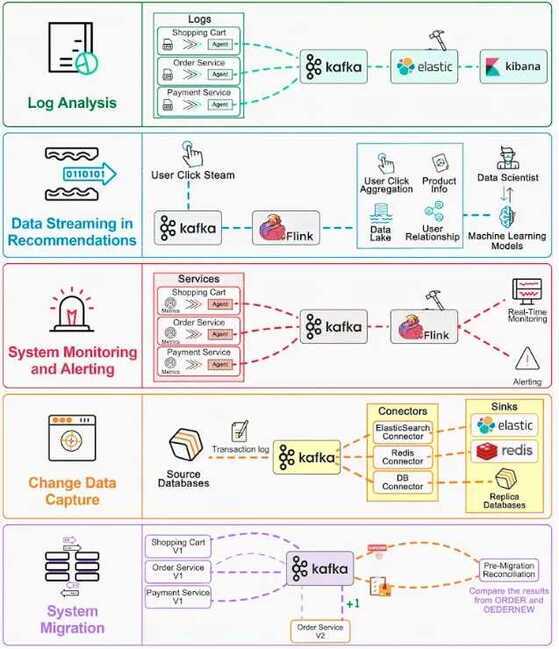
Application
- Building real-time streaming data pipelines that reliably get data between systems or applications
- Building real-time streaming applications that transform or react to the streams of data
- Publish and Subscribe - Read and write streams of data like a messaging system
- Process - Write scalable stream processing applications that react to events in real-time
- Store - Store streams of data safely in a distributed, replicated, fault-tolerant cluster
Example Applications
- Managing passenger and driver matching at Uber
- Providing real-time analytics and predictive maintenance for British Gas' smart home
- Performing numerous real-time services across all of LinkedIn
- Streaming videos with persistence and consumer offset
- For example, in a credit card transaction processing system, there will be a client application, perhaps an online store, responsible for sending each transaction to Kafka immediately when a payment is made. Another application is responsible for immediately checking this transaction against a rules engine and determining whether the transaction is approved or denied. The approve/deny response can then be written back to Kafka and the response can propagate back to the online store where the transaction was initiated. A third application can read both transactions and the approval status from Kafka and store them in a database where analysts can later review the decisions and perhaps improve the rules engine.