Confluent Intelligence Overview
Confluent Intelligence enables you to seamlessly integrate large-language models (LLMs), machine learning (ML), retrieval-augmented generation (RAG), and agentic AI into your streaming data workflows.
Confluent Intelligence is a suite of the following features.
- Streaming Agents: Use Streaming Agents to build AI workflows that can invoke tools to interact with external systems, perform actions, or retrieve information as part of an AI workflow.
- Real-time Context Engine: The Real-time Context Engine continuously materializes enriched enterprise data sets into a fast, in-memory cache and serves them to AI systems by using the Model Context Protocol (MCP), all fully managed within Confluent Cloud.
- Built-in machine learning (ML) functions: Confluent Cloud for Apache Flink provides built-in functions for building ML workflows, like ML_DETECT_ANOMALIES and ML_FORECAST.
Streaming Agents
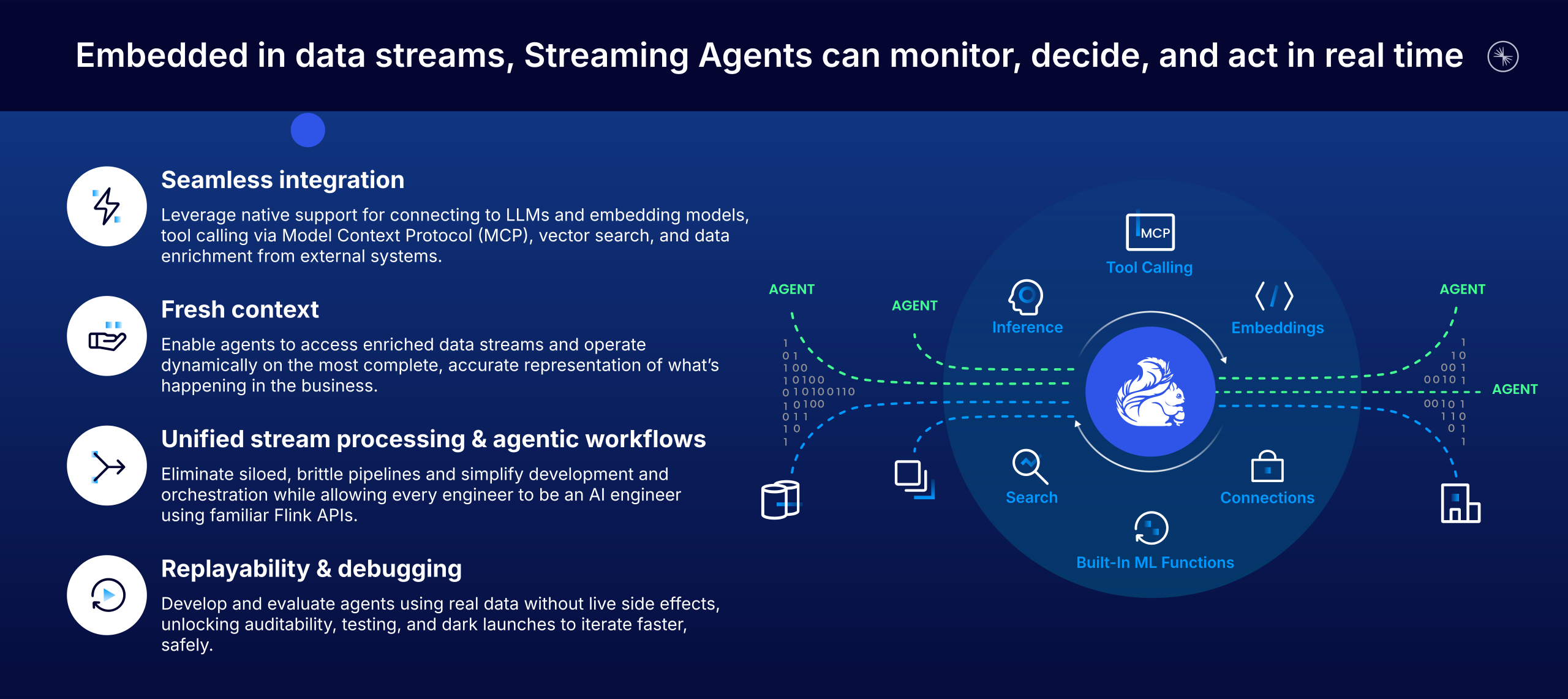
The key to agentic AI isn’t building better LLMs – it’s data readiness.
Streaming Agents bridge the gap between enterprise data and AI capabilities by providing:
- Real-time data access: Fresh, contextualized data for AI decision-making
- Unified data processing: Seamless integration of streaming and batch data
- Enterprise data utilization: Effective use of existing enterprise data assets
- Context-aware automation: Agents that understand and act on current business context
With Streaming Agents, you can:
- Unify stream processing and agentic AI workflows using familiar Flink APIs, simplifying development and enabling every engineer to be an AI engineer.
- Integrate seamlessly with any tool, model, and data system.
- Access real-time context to enable agents to operate dynamically on live operational events and effectively use LLMs as reasoning engines to plan, decide, and act.
- Ensure agents are secure and trustworthy with full visibility, control, and secure, governed event flows.
Real-time Context Engine
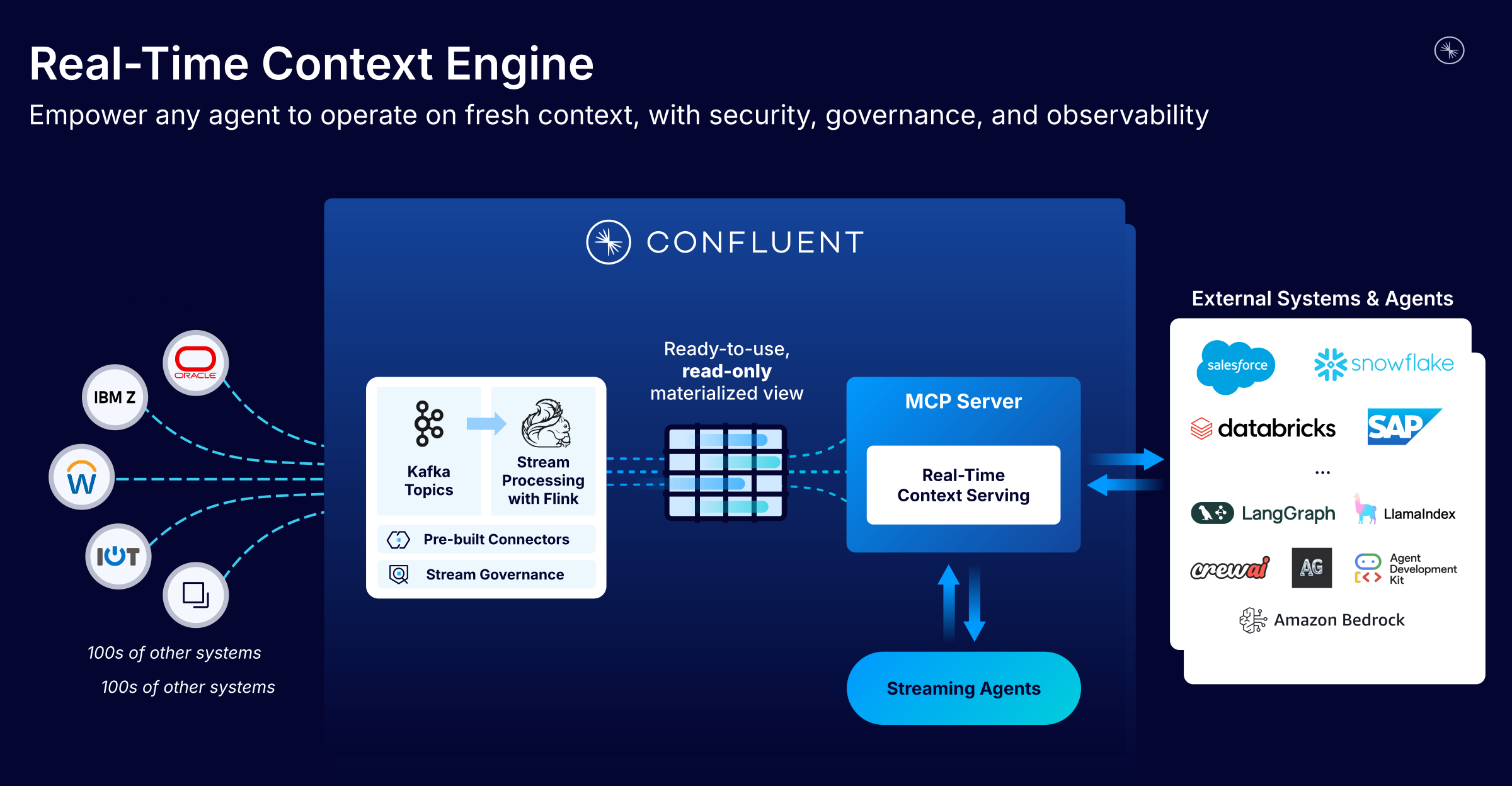
The Real-time Context Engine enables AI agents to query the most up-to-date context, grounding their responses in real-time data. It supports structured data with lookup by primary key. The Real-time Context Engine is available to AI agents by using MCP and works with any agent, hosted anywhere, as long as it supports MCP.
Real-time Context Engine tables are always loaded in memory, so they provide low-latency response times for agent queries. AI agents require fast access to relevant data to make informed decisions and provide accurate responses. The Real-time Context Engine provides the low-latency data access needed for real-time AI agent context serving.
How to Build a Real-Time Context Engine for AI Agents Using Event Driven Architectures - OSO
Built-in machine learning (ML) functions
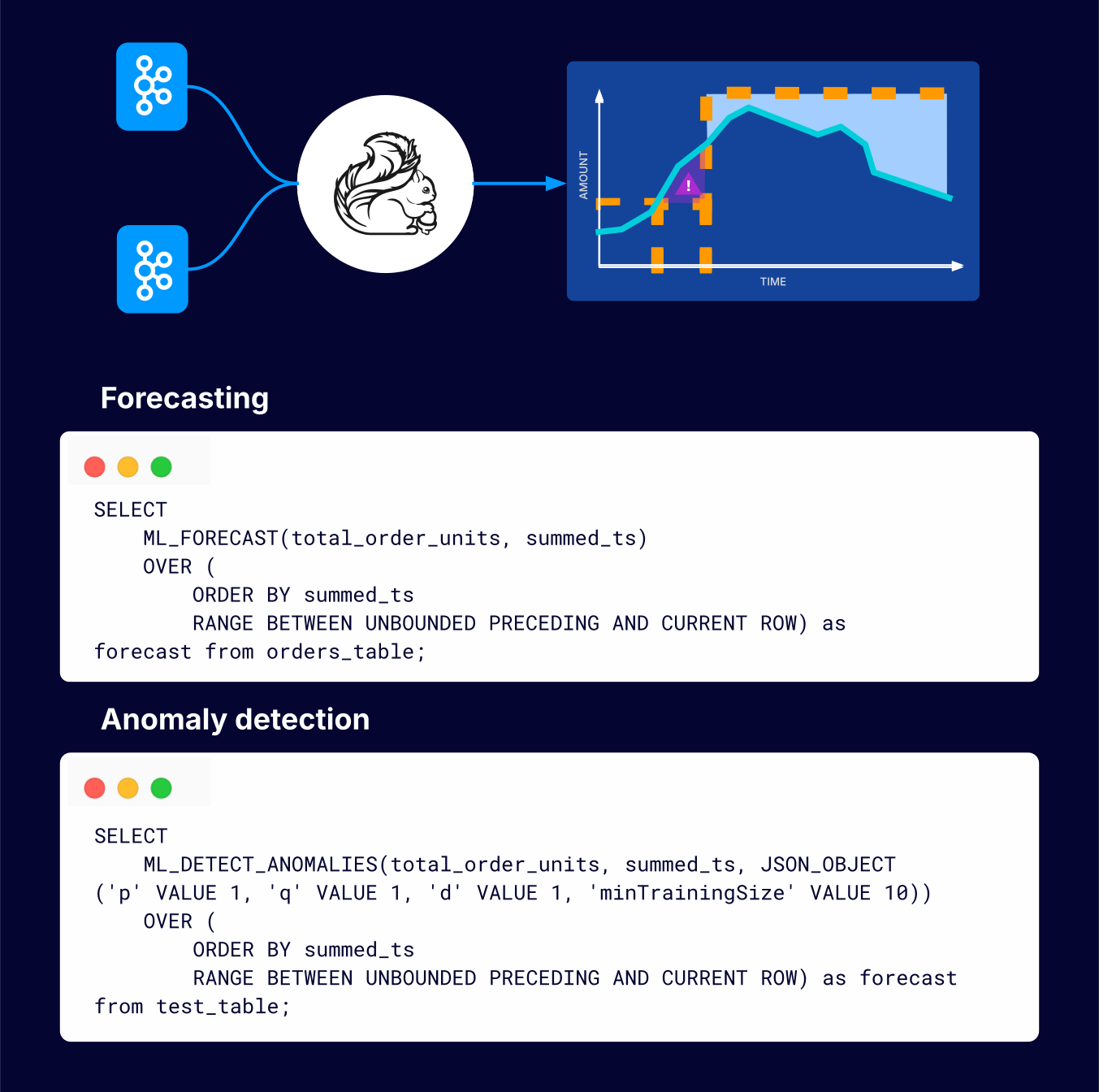
Simplify complex data science tasks into Flink SQL statements. Built-in ML functions enable forecasting and anomaly detection with Flink SQL functions to derive real-time insights, with no ML expertise or model building needed.
- Do continuous forecasting on time-series streaming data, with out-of-the-box configuration (Auto-ARIMA) or custom user configuration, like training size, seasonality, and forecast horizon.
- Perform anomaly detection for each new event.
- See real-time visualizations, like time-series charts and graphs showing forecasted values and anomalies.
Built-in ML Functions provide time-series Forecasting and Anomaly Detection SQL functions for streaming data, enabling you to derive real-time insights. These functions simplify complex data science tasks into Flink SQL, providing a familiar yet powerful way to apply AI to streaming data. Built on top of popular ML algorithms like ARIMA optimized for real-time performance, the functions deliver accurate forecasts and reliable anomaly detection.
With built-in ML functions, you can:
- Eliminate the need for batch processes
- Bridge the gap between data analysis and machine learning
- Gain real-time, actionable insights
Built-in ML functions make it easier for you to harness the full potential of AI-driven analytics. SQL functions enable real-time analysis, reduce complexity, and speed up decision-making by delivering insights immediately as the data is ingested. Built-in forecasting and anomaly detection make real-time AI accessible to everyone, enabling agents and teams to make smarter decisions faster.
Common use cases include:
- Operational monitoring: Detect system failures or performance issues in real time, minimizing downtime.
- Financial forecasting: Predict trends and identify irregular transactions in streaming financial data.
- IoT analytics: Monitor sensor data in industrial settings to detect equipment malfunctions or predict maintenance needs.
- Retail analytics: Forecast demand and optimize inventory by identifying purchasing trends in real time.
- Marketing: Monitor marketing campaign performance in real-time.
Time-series foundation models and Real-time Context Engine updates (Confluent demos, 2026): the AI forecast function in Confluent Cloud Flink takes a model parameter, so you can switch between IBM Granite TTM, FlowState, PatchTST and Google TimesFM (the default) with no other setup; the models support forecasting and anomaly detection. In an IBM Granite demo hourly Spanish energy demand was forecast 96 hours ahead, and the stored forecast closely tracked later actuals (no accuracy figures given). The model name "PatchTST" is inferred from a garbled caption.
- Upsert mode: Real-time Context Engine now supports upsert-mode tables, so agents querying through the RTCE MCP server get only the latest state per key instead of a changelog; enable it per topic with a toggle in the console (MCP tools: get metadata, list topics, query data)
- Lightning queries: a REST API for direct key lookups on RTCE-enabled topics (previously MCP only), using a global API key, returning schema plus data, for low-latency application lookups
- Demo: Real-time anomaly detection and forecasting, Real-Time Context Engine for AI agents (YouTube)
Links
- event-driven-multi-agent-systems
- Build AI with Confluent Intelligence in Confluent Cloud | Confluent Documentation
- Introducing Real-Time Context Engine for AI
- Confluent Intelligence: Real-Time AI With Apache Kafka® and Apache Flink®
- Confluent Intelligence - YouTube
- Detect Anomalies in Data with Confluent Cloud for Apache Flink | Confluent Documentation
- Using Apache Flink for Model Inference: A Guide for Real-Time AI Applications | Confluent
- GitHub - confluentinc/demo-confluent-fraud-agent · GitHub ⭐ 7