High-Level Architectural Design Overview
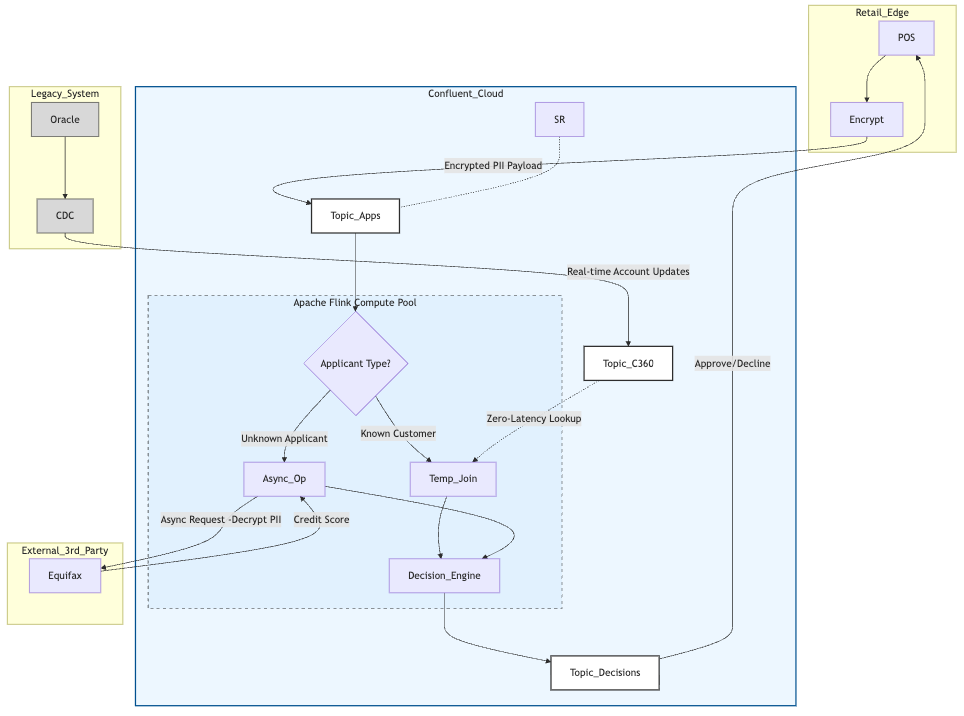
High-Level Architecture Diagram Description
The architecture follows a "Split-Enrich-Merge" pattern, designed to isolate the high-latency external dependencies from the low-latency internal logic.
- Ingestion Layer: POS terminals send Loan Application events to the
loan_applicationstopic in Confluent Cloud via a secure API Gateway (using Confluent REST Proxy or native Producer clients). - Routing Layer (Flink): A Flink job consumes the
loan_applicationstopic. It inspects the payload to determine if the applicant isKNOWNorUNKNOWN. It splits the stream into two distinct logical paths:internal_processing_streamandexternal_processing_stream. - Internal Enrichment Layer (The Fast Lane):
- The
internal_processing_streamis joined with thecustomer_360topic. - The
customer_360topic is populated by the Oracle CDC connector, containing real-time snapshots of existing customers. - The join is a Temporal Join, ensuring the application is evaluated against the customer's status at the exact time of application.
- The
- External Enrichment Layer (The Async Lane):
- The
external_processing_streamis processed by a Flink job utilizing Async I/O. - This job makes a non-blocking HTTP request to the Credit Bureau API.
- While waiting for the bureau to respond (e.g., 500ms), Flink continues to process other records.
- Once the response arrives, the event is enriched with the credit score.
- The
- Decisioning & Egress:
- Both streams merge into a final Scoring Operator (Flink SQL
CASElogic). - The result (
APPROVED/DECLINED) is written to theloan_decisionstopic. - The POS system (listening via WebSocket or long-polling) receives the decision.
- Both streams merge into a final Scoring Operator (Flink SQL
Detailed Data Flow and Schema Design
Data Contract: The Loan Application Event
Defining the schema is the first step in ensuring system stability. We utilize Avro for its compact binary format and schema evolution capabilities.
{
  "namespace": "com.bfb.pos",
  "name": "LoanApplication",
  "type": "record",
  "fields":}},
    {"name": "applicant_details", "type": "com.bfb.PII.Applicant"}
  ]
}
Note the applicant_details field. This contains sensitive PII (SSN, Name, Address) and must be encrypted.
Handling The Known Customer: The Temporal Join Pattern
For known customers, BFB requires sub-millisecond decisioning. Querying the Oracle database directly for every POS transaction is an anti-pattern; it introduces latency and creates a dependency that can crash the core banking system under load.
Instead, we use the Side-Car Database Pattern implemented via Kafka.
- CDC Ingestion: The Oracle CDC Source Connector monitors the Redo Logs of the core banking system. Any change to a customer's balance or risk tier is immediately captured and written to the
customer_360Kafka topic. - Compacted Topic: This topic is configured with
cleanup.policy=compact. This ensures that we always retain the latest state for everycustomer_id, effectively turning the Kafka topic into a high-performance, streaming database table. - Flink Temporal Join:
In Flink SQL, we model this topic as a versioned table. When a loan application arrives at T1, Flink joins it with the state of the customer record as it existed at T1.
SELECT
  L.application_id,
  C.credit_limit - C.current_balance AS available_credit
FROM loan_applications AS L
JOIN customer_360 FOR SYSTEM_TIME AS OF L.timestamp AS C
ON L.customer_id = C.customer_id;
This operation happens entirely within Flink's managed state, requiring no external network calls, ensuring maximum speed.
Handling The Unknown Applicant: The Async I/O Pattern
This workflow represents the highest technical risk due to the reliance on external Credit Bureau APIs. These APIs are slow (200ms - 2s) and unreliable.
The Naive Approach (And Why It Fails): A standard implementation might use a synchronous function: get_credit_score(ssn). If the API takes 500ms, the processing thread blocks for 500ms. If the system has 10 processing threads, the maximum throughput is limited to 20 events per second (10 threads / 0.5s). To handle holiday traffic of 10,000 events/second, BFB would need to provision 5,000 threads, which is prohibitively expensive and resource-intensive.
The Flink Async Solution:
Flink’s Async I/O operator decouples the request from the response.
- Request: Flink sends the HTTP request to the Credit Bureau.
- Suspend: The operator suspends the processing of that specific event without blocking the thread. The thread immediately moves on to process the next event.
- Buffer: Flink maintains a buffer of "in-flight" requests.
- Callback: When the Credit Bureau API responds (e.g., 500ms later), the callback is triggered, the result is matched to the original event, and processing resumes.
By using this pattern, a single Flink task can manage thousands of concurrent API calls, maintaining high throughput even when the external API is slow.
Implementation with Flink SQL:
Confluent Cloud Flink supports this via the KEY_SEARCH_AGG function or specialized REST lookup connectors that support the lookup.async hint.
SELECT
  L.application_id,
  Bureau.fico_score
FROM loan_applications AS L
JOIN LATERAL TABLE (
  KEY_SEARCH_AGG(
    'CreditBureauRestService',
    DESCRIPTOR(ssn),
    L.applicant_ssn,
    MAP['async_enabled', 'true', 'capacity', '100']
  )
) AS Bureau ON TRUE;
This declarative SQL approach abstracts the complexity of threading and callbacks, allowing BFB’s developers to focus on business logic rather than concurrency programming.