Income Tax
| Income Tax Slabs | Tax Rate for Individual & HUF Below the Age Of 60 Years |
|---|---|
| Up to ₹2,50,000* | Nil |
| ₹2,50,001 to ₹5,00,000 | 5% of total income exceeding ₹2,50,000 |
| ₹5,00,001 to ₹10,00,000 | ₹12,500 + 20% of total income exceeding ₹5,00,000 |
| Above ₹10,00,000 | ₹1,12,500 + 30% of total income exceeding ₹10,00,000 |
- An additional 4% Health & education cess will be applicable on the tax amount calculated as above.
- Surcharge: 10% of income tax, where total income exceeds Rs.50 lakh up to Rs.1 crore.
- Surcharge: 15% of income tax, where the total income exceeds Rs.1 crore.
- Surcharge of 25% on Total Income more than Rs. 2 Cr to Rs. 5 crore
- Surcharge of 37% on Total Income more than Rs. 5 Cr
So ~3cr or 2% of Indians out of 140cr invest.
ITR filings for FY 20/21 by income.
- ~4.8cr ₹5lks
- ~90lks ₹5 to ₹10lks
- ~43lks ₹10lks
If people have to invest or spend more, they need to earn at least ₹2.5lks/yr?
Incomes exempt from paying tax
- Income from Agriculture (Agriculture Income)
- Gifts Received from Relatives
- Income from Gratuity
- Scholarships
- Certain Pensions - Pensions received by recipients of gallantry awards like the Mahavir Chakra, Param Vir Chakra, and Vir Chakra are tax-free. Additionally, the pension received by family members of Indian Armed Forces personnel is also exempt from tax.
Certain Pensions | Zee Business
Gratuity
- Lifetime Cumulative Limit: The ₹20 lakh limit for private sector employees is a cumulative, lifetime cap across all employers.
- Taxable Portion: Any gratuity amount received above the applicable exemption limit is fully taxable as "Income from Salary".
- Minimum Service: Generally, an employee must complete a minimum of five years of continuous service to be eligible for gratuity payment (the condition is waived in case of death or disablement).
- Income Tax Exemption on Gratuity
New Tax Regime vs Old Tax Regime
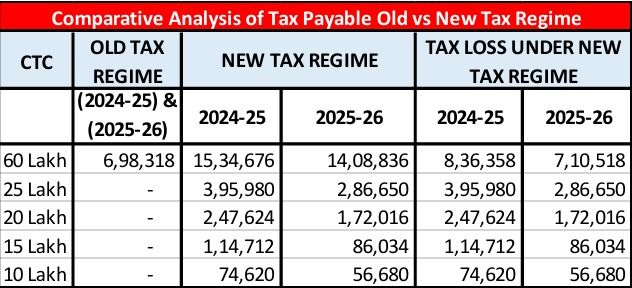
The Old Tax Regime is almost dead
How income tax is computed (FY 2025-26) from Understanding Indian Tax System (Labour Law Advisor), a Hinglish walkthrough. Several figures in the transcript are garbled, and the slab and rebate numbers below were inferred from the tax amounts, so verify them against the Budget before relying on them.
- Five heads of income: salary, house property, business or profession, capital gains, other sources (FD interest, dividends, gambling, gifts from non-relatives). Gifts from close relatives are not income, and the Centre does not tax agricultural income
- Accrual: FD interest is taxed each year as it accrues even if paid at maturity, unrealised share and MF gains are untaxed until sale, and a third house is taxed on deemed rent even if vacant
- New regime slabs: 0-4L nil; 4-8L 5%; 8-12L 10%; 12-16L 15%; 16-20L 20%; 20-24L 25%; above 24L 30%. The only major deduction is the ₹75,000 standard deduction for salaried people; the old regime keeps 80C, home-loan interest, insurance premiums and HRA
- Rebate and marginal relief: section 87A makes tax nil up to ₹12L taxable income in the new regime (₹5L, a ₹12,500 rebate, in the old). Above ₹12L marginal relief caps tax at the income over ₹12L, so a ₹50,000 raise just past the limit is taxed away almost entirely
- Special flat rates get no rebate: crypto, gambling and game-show winnings are taxed at 30% with no basic exemption; LTCG on listed shares and equity MFs is 12.5% above ₹1.25L a year and STCG is 20%. With the same ₹12L income, salary pays nothing, LTCG pays about ₹87,000, and gambling or crypto about ₹3.74 lakh
- Surcharge and cess: surcharge applies above ₹50L income (the video does not mention that the new regime caps it at 25%), then 4% health and education cess on tax plus surcharge
- Collection and filing: TDS, TCS and advance tax all credit against your PAN and show up in AIS/TIS, Form 26AS and Form 16; filing is mandatory above the basic exemption (₹4L new, ₹2.5L old) and worth doing for nil income to claim refunds and build income history; the return is due 31 July for individuals. Salaried and capital-gains-only filers can switch regimes every year, while business filers cannot
- The Income Tax Act 2025 replaces the 1961 Act and renames assessment and previous year to just "tax year"; see Deductions for the section mapping
Taxation Comparison
Rs 10 Crore salary after taxes
- USA: 37% → ₹6.3 CR
- China: 45% → ₹5.5 CR
- Japan: 55.97% → ₹4.4 CR
- Germany: 45% → ₹5.5 CR
- India: 42.74% → ₹5.7 CR
- UK: 45% → ₹5.5 CR
- France: 55.4% → ₹4.5 CR
- Italy: 47.2% → ₹5.3 CR
- Brazil: 27.5% → ₹7.25 CR
- Canada: 33% → ₹6.7 CR
- Russia: 13% → ₹8.7 CR
- S. Korea: 45% → ₹5.5 CR
- Australia: 45% → ₹5.5 CR
- Spain: 54% → ₹4.6 CR
- Mexico: 35% → ₹6.5 CR
- Indonesia: 35% → ₹6.5 CR
- Netherlands: 49.5% → ₹5.05 CR
- Saudi Arabia: 0% → ₹10 CR
- Turkey: 40% → ₹6 CR
- Switzerland: 40% → ₹6 CR
- Taiwan: 40% → ₹6 CR
- Poland: 36% → ₹6.4 CR
- Sweden: 52.3% → ₹4.77 CR
- Belgium: 53.5% → ₹4.65 CR
- Thailand: 35% → ₹6.5 CR
- Argentina: 35% → ₹6.5 CR
- Austria: 55% → ₹4.5 CR
- Norway: 39.6% → ₹6.04 CR
- UAE: 0% → ₹10 CR
- Israel: 50% → ₹5 CR
- South Africa: 45% → ₹5.5 CR
- Malaysia: 30% → ₹7 CR
- Denmark: 55.9% → ₹4.41 CR
- Singapore: 22% → ₹7.8 CR
- Philippines: 35% → ₹6.5 CR
- Ireland: 52% → ₹4.8 CR
- Vietnam: 35% → ₹6.5 CR
- Hong Kong: 15% → ₹8.5 CR
- Chile: 40% → ₹6 CR
- New Zealand: 39% → ₹6.1 CR
- Finland: 56.9% → ₹4.31 CR
- Colombia: 39% → ₹6.1 CR
- Portugal: 48% → ₹5.2 CR
- Czechia: 23% → ₹7.7 CR
- Hungary: 15% → ₹8.5 CR
- Greece: 45% → ₹5.5 CR
- Ecuador: 35% → ₹6.5 CR
- Peru: 30% → ₹7 CR
Rs 10 crore salary: How much you take home in US vs India vs UAE vs Finland? Here's a comparison
Links
- Got an income tax notice? Here are common types of tax notices and what to do to avoid penalties - The Economic Times
- Filing ITR for FY2024-25? Mistakes in HRA claims, capital gains tax calculation are among 7 errors to avoid - The Economic Times
- You do not pay 30% tax if you fall in the 30% slab! Marginal vs. effective tax rate
- New Income Tax Rules 2025: The 7 Major Changes You MUST Know