Climate Change
Earth / Environment / Global warming
- the-uninhabitable-earth
- Earth overshoot day - 27 July
- 10 years to transform the future of humanity -- or destabilize the planet | Johan Rockström - YouTube
- International Relations this Week by Prof Pushpesh Pant 36 | For UPSC/IAS - YouTube
- This CAN'T be true... Minute Earth
- Packaging might be more environment friendly than non packaged food
- Floating offshore wind farms can make living closer to shore better, since water problem can be solved by desalination
- Why sharks matter - with David Shiffman - YouTube
- El Niño 2023 could be a monster! - YouTube
- The Broken Economics of the Oceans - YouTube
- Finshots Recap - The best stories on climate change
- What the Fossil Fuel Industry Doesn't Want You To Know | Al Gore | TED - YouTube
- Has Earth Already Crossed MAJOR Tipping Points? | Full Episode | Weathered: Earth’s Extremes - YouTube
- What Will Our World Look Like at 4 Degrees? - YouTube
- Conservation
- Contributing money
- Games are the most important thing to change climate change (to keep people away from spending on physical things and keep them from travelling)
- Coolant - Home
- solar reflective paints
- Could This Be India’s Solution to the Heatwave Crisis? - YouTube
- Best Cool Roof Paints | Waterproofing Treatment On Terrace | LuminX Cool Roof Paint | Excel CoolCoat - YouTube
- LuminX Cool Roof Coating Is BETTER Than Traditional Methods For Terrace Waterproofing - YouTube
- How to Apply LuminX Cool Roof Coating | Step-by-Step Guide - YouTube
- Rising seas will swallow New Orleans. People need to start relocating now, scientists say
- Not A Fan, Not AC: This Cheap Cooling System Works Without Using Electricity
- NESCOD (No Electricity and Sustainable Cooling On Demand) is a breakthrough passive cooling technology developed by researchers at Saudi Arabia's King Abdullah University of Science and Technology (KAUST). It cools environments entirely without electricity, compressors, or harmful refrigerants by utilizing natural chemical processes and solar energy.
- Cooling: The system uses a process called endothermic dissolution. When ammonium nitrate (a salt commonly used in fertilizers) is dissolved in water, it aggressively absorbs heat from the surrounding environment. Tests have shown this chemical reaction can rapidly drop temperatures from 25°C to 3.6°C in just 20 minutes.
- Regeneration: Once the salt has absorbed the heat and the cooling process is complete, solar thermal energy is used to evaporate the water. This causes the ammonium nitrate to naturally re-crystallize, recharging the system so it can be used again.
- Water Conservation: In arid regions, the system can capture the evaporated water vapor through solar distillation and reuse it, achieving a closed-loop cycle.
- NESCOD (No Electricity and Sustainable Cooling On Demand) is a breakthrough passive cooling technology developed by researchers at Saudi Arabia's King Abdullah University of Science and Technology (KAUST). It cools environments entirely without electricity, compressors, or harmful refrigerants by utilizing natural chemical processes and solar energy.
Environmental Sciences
Carbon Cycle, Nitrogen Cycle, Phosphorus and Sulphur Cycle - PMF IAS
AQI / Air Quality / Air Pollution
- Why India's Air is So Deadly (And Getting Worse!) | Dhruv Rathee - YouTube
- The smog cloud affecting south Asia is now so big it can be seen from space.
- How This Couple Defeated Toxic Air Pollution To Breathe 'Mountain Air' While Staying In Delhi - YouTube
- Delhi's Air Quality Readings Top 1,700 as Residents Choke | Vantage With Palki Sharma - YouTube
- आज भी AQI 500 है, कहां भाग कर जाएं लोग, दूसरे शहर भी बेहाल - YouTube
- क्या होगा इस हवा का? | Air Pollution in North India - YouTube
- What’s Choking Indian Cities To Death? | Reality of Diwali & Pollution In India | Akash Banerjee - YouTube
- Your Family is at Risk: Harmful Gases from Kitchen, Walls & Car | BreatheEasy | FO426 Raj Shamani - YouTube
- Cleanest air quality 2025: World's top 10 cities with best air quality index
- Control indoor AQI without air purifier – Dyson expert’s 5 simple habits to de-smog your home - Technology News | The Financial Express
- Praan air purifier
Keeling Curve
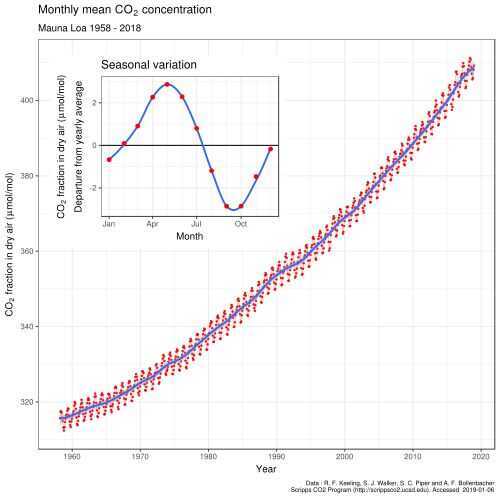
The Keeling Curve is a graph of the accumulation of carbon dioxide in the Earth's atmosphere based on continuous measurements taken at the Mauna Loa Observatory on the island of Hawaii from 1958 to the present day. The curve is named for the scientist Charles David Keeling, who started the monitoring program and supervised it until his death in 2005.
Keeling's measurements showed the first significant evidence of rapidly increasing carbon dioxide(CO2) levels in the atmosphere. According to Dr Naomi Oreskes, Professor of History of Science at Harvard University, the Keeling curve is one of the most important scientific works of the 20th century. Many scientists credit the Keeling curve with first bringing the world's attention to the current increase of CO in the atmosphere.
Animal Cruelty / Veganism / Non-Veg / Vegetarian / Vegan
- Turn vegan (saves water, saves greenhouse gases, saves money)
- Saying no to overconsumption
- There is no humane way of using animals
- The greatness of a nation and its moral progress can be judged by the way its animals are treated -- Mohandas Karamchand Gandhi
- You have just dined, and however scrupulously the slaughterhouse is concealed in the graceful distance of miles, there is complicity. --Ralph Waldo Emerson
- Media
- Racing Extinction
- Cowspiracy
- Seaspiracy (2021)
- Food, Inc. (2008)
- The Cove (2009)
- Earthlings - Earthlings Documentary
- Dominion (2018) - full documentary [Official] - https://www.dominionmovement.com
- The Dark Truth About Dairy Farming in India | What Farmers Aren’t Told - YouTube
- The Photograph of a Dead Chicken — Ian Knauer
- Born To Die (The Life of A Broiler Chicken) » Tamara Kenneally Photography
- We Went Inside the Milk Industry of India, With Hidden Cameras 😳 - YouTube
- Why the World’s Fittest People Have Stopped Drinking Milk (5 Shocking Reasons) 😳 - YouTube
- We Made Paneer, Cheese & Dahi Without a Drop of Cow Milk! - YouTube
- Agar agar is a natural, gelatinous substance derived from red algae (seaweed), widely used as a plant-based, vegan alternative to gelatin. It is odorless, tasteless, and colorless, sold as flakes, powder, or bars. It sets firmly at room temperature, remains stable up to 85° C, and is used for jellies, puddings, and thickeners.
Water
What is the Expiry Date of Water? 🤔
Often, we decide the 'expiry date' of water based on our own convenience and mindset, which has absolutely no scientific basis. Consider this paradox:
- 🚰 In Cities: Where tap water comes daily, yesterday's water is considered 'stale' and thrown away. (Expiry date: 1 day)
- ⏳ Where water comes once in 2 to 8 days: The exact same water is considered perfectly fresh and drinkable for those 2 to 8 days.
- 🍾 At weddings and events: The moment a fresh bottle of packaged water is placed in our hands, the older, half-filled bottle is instantly dismissed as 'useless' and discarded.
The Reality on the Other Side
- 🌵 In Deserts: While traveling, every single drop of water remains life-giving and fresh until the next water source is found.
- 🌧️ In Nature: Water in dams and ponds remains perfectly usable until the next monsoon (and even up to 2-3 years during droughts).
- 🕳️ In Borewells: The water we pump from 50 to 500 feet below the ground has been sitting there for hundreds or thousands of years, yet it remains safe, pure, and healthy.
The Conclusion (Food for Thought)
In reality, water has no expiry date. Its expiration is determined only by our mindset and its availability. When water is easily accessible, we call it stale; when there is a scarcity, the same water becomes priceless.
Therefore, use water wisely, responsibly, and with restraint. Otherwise, long before the water actually runs out, our careless mindset will leave us thirsty.