Education System
Global Education
Free Open Source Education for all fields and all classes from nursery to college - same over all the world. Central database, updated constantly and regularly to create global best education.
- Should be comprehensive and also summarized - Summarized for lectures and comprehensive for students reading
- Should develop overall personality
- Develop growth mindset
- Create life long learners
https://www.notboring.co/p/primer-the-ambitious-home-for-ambitious
How to Make Learning as Addictive as Social Media | Luis Von Ahn | TED - YouTube
Best Education System in the World
Which country's primary education model is the best? - Quora
- Finland:
- Approach: Emphasizes equal opportunities, minimal standardized testing, and a focus on student well-being.
- Curriculum: Broad and flexible, allowing teachers to tailor lessons to students' needs.
- Teacher Training: Highly qualified teachers with master’s degrees and significant professional autonomy.
- Singapore:
- Approach: Strong emphasis on mathematics and science, with a rigorous curriculum and high expectations.
- Assessment: Regular assessments to track progress, but also a focus on creative thinking and problem-solving skills.
- Teacher Support: Continuous professional development for teachers.
- Japan:
- Approach: Focus on discipline, respect, and community involvement in education.
- Curriculum: Emphasizes moral education alongside academics, fostering a well-rounded character.
- Classroom Environment: Collaborative learning and group work are common.
- Canada:
- Approach: Inclusive and diverse education system that values multiculturalism.
- Curriculum: Student-centered learning with a focus on critical thinking and creativity.
- Teacher Support: Teachers receive substantial support and professional development.
- Germany:
- Approach: Strong vocational education programs integrated with academic ones, preparing students for various career paths.
- Curriculum: Emphasizes practical skills alongside theoretical knowledge.
- Tracking System: Early tracking into different educational paths based on student performance.
- Netherlands:
- Approach: Focus on child-centered education and learning through play, especially in early years.
- Curriculum: Offers a balance between academic subjects and social-emotional learning.
- Inclusivity: Strong focus on inclusive education for all students.
Key Factors for Success
- Teacher Quality: Highly trained and motivated teachers are crucial for effective education.
- Student-Centered Learning: Tailoring education to meet the needs of individual students can enhance engagement and learning outcomes.
- Parental and Community Involvement: Strong support from families and communities contributes to student success.
- Equity: Ensuring all students have access to quality education regardless of background is vital.
These Countries Have a Well-Developed Public Education System | U.S. News
Indian Education System
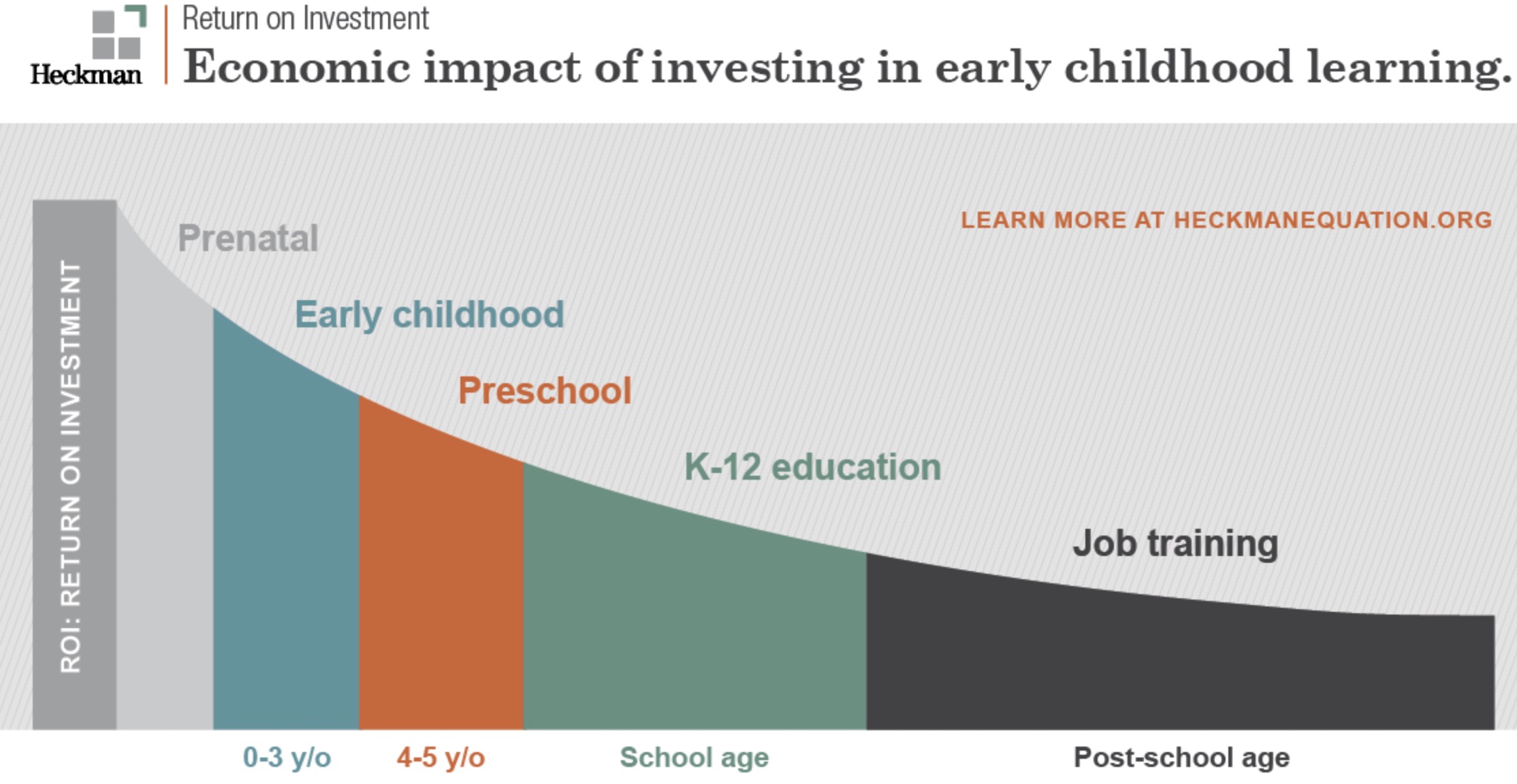
Heckman Curve
The Heckman Curve shows that the highest rate of economic returns comes from the earliest investments in children, providing an eye-opening understanding that society invests too much money in later development when it is often too late to provide great value. It shows the economic benefits of investing early and building skill upon skill to provide greater success to more children and greater productivity and reduce social spending for society.
"The family into which a child is born plays a powerful role in determining lifetime opportunities...Some kids win the lottery at birth, far too many don't - and most people have a hard time catching up over the rest of their lives."
The Heckman Curve - The Heckman Equation
Boards
- International Baccalaureate (IB) and Cambridge curricula
- ICSE
- CBSE
- CBSE vs ICSE vs IB vs IGCSE (Cambridge) - Comparing Boards - Which is best?
- CBSE vs ICSE vs IB vs Cambridge - my authentic opinion in 2025
- Understand all about school boards: CBSE, ICSE or IB?
- ⚔️ Battle between Boards ⚔️ | CBSE Vs Cambridge | Choose One in 10 Minutes
- Cambridge Curriculum: What Are the Advantages and What Do Parents Get Wr...
- Which board is best in India ? CBSE vs ICSE vs CAMBRIDGE (IGCSE) vs IB v...
- Why I Changed From CBSE To Cambridge(IGCSE) Curriculum. Should You Also ...
- CBSE vs ICSE vs IB vs Cambridge – Kaunsa Board Best Hai? Honest Opinion ...
- CBSE vs ICSE vs IGCSE vs IB: Choosing the Right Board
- Homeschool Elective - Music Appreciation | Flip Through | The Good and t...
- IB Education System in India - Everything you need to know | Facts, Myth...
- ICSE Vs CBSE Vs International Board – Which Board Is Best For Your Child...
- Does WiFi Make Students Smarter? - Cal Newport
Mandatory Subjects in School
- Economics
- Taxes
- Insurance
- Personal finance
- Coding - https://www.codedex.io/
- Cooking
- Basic home repair
- Self defence
- Survival skills
- Social etiquette
- Public speaking
- Car maintenance
- Stress management (emotions)
Non Regrettable Minute
In the context of learning, a "non-regrettable minute" refers to a moment where a learner makes a decision or chooses an action that, despite the uncertainty of the environment, leads to a beneficial outcome in terms of learning progress or knowledge gain. This concept is central to "no-regret learning," a field that focuses on online learning strategies where the learner can adapt their choices over time to minimize the cumulative loss, even when facing unpredictable or noisy feedback.
Online Learning and the No-Regret Framework
- Online Learning: In online learning, learners interact with an environment and receive feedback (or lack thereof) for each decision. They must learn to adapt their strategies based on this feedback while making decisions that are immediately beneficial.
- No-Regret Learning: This framework aims to find strategies that, even if the environment is uncertain or noisy, ensure that the cumulative loss is minimized compared to any other strategy that could have been chosen.
- Non-Regrettable Minute: A "non-regrettable minute" in this context refers to a specific instance where a learner makes a decision that, in retrospect, proves to be a good one and contributes to their overall learning progress.
Examples in Different Contexts
- Route Optimization: Imagine choosing a route to work each morning. Some days, the chosen route might be faster, and some days it might be slower due to traffic. A "non-regrettable minute" in this context could be choosing a route that consistently provides good travel time, even if the environment is unpredictable.
- Online Game Playing: In an online game, a player might choose different actions based on limited information. A "non-regrettable minute" would be an action that, even with imperfect knowledge, leads to a positive outcome for the player, such as gaining resources or progressing towards a goal.
- Machine Learning: In machine learning, a model might make predictions based on incomplete data. A "non-regrettable minute" could be a prediction that, despite the uncertainty, results in the model making a correct classification or achieving a desired outcome.
Key Characteristics of Non-Regrettable Minutes
- Adaptive Strategies: Learners use strategies that adapt to the environment and past experiences.
- Minimizing Cumulative Loss: The overall goal is to minimize the total negative impact of all decisions over time.
- Robustness: The strategies should be robust to uncertainty and variations in the environment.
In essence, a "non-regrettable minute" is a moment where the learner makes a smart decision that contributes to their learning, even if the environment is uncertain or the consequences are not immediately apparent.
Interview Prep Model
- Do mock interviews
- Tell what's wrong with the candidate
- Share the module / courses and full plan on how to be better
LMS (Learning Management System)
- GitHub - frappe/lms: Easy to Use, 100% Open Source Learning Management System ⭐ 2.9k
- Monetise your expertise - Graphy
- Edmingle - Build, Manage & Scale Your Online Academy
School Education facilities as a Service
Service based company for education, people don't know how to train teacher, etc. create a consolidation and centralisation in education sector, automate processes, learning, etc. give education as a service to b2b also
Parenting (app for parents to manage kids)
Daily tasks that you can do with your kid with home items, etc